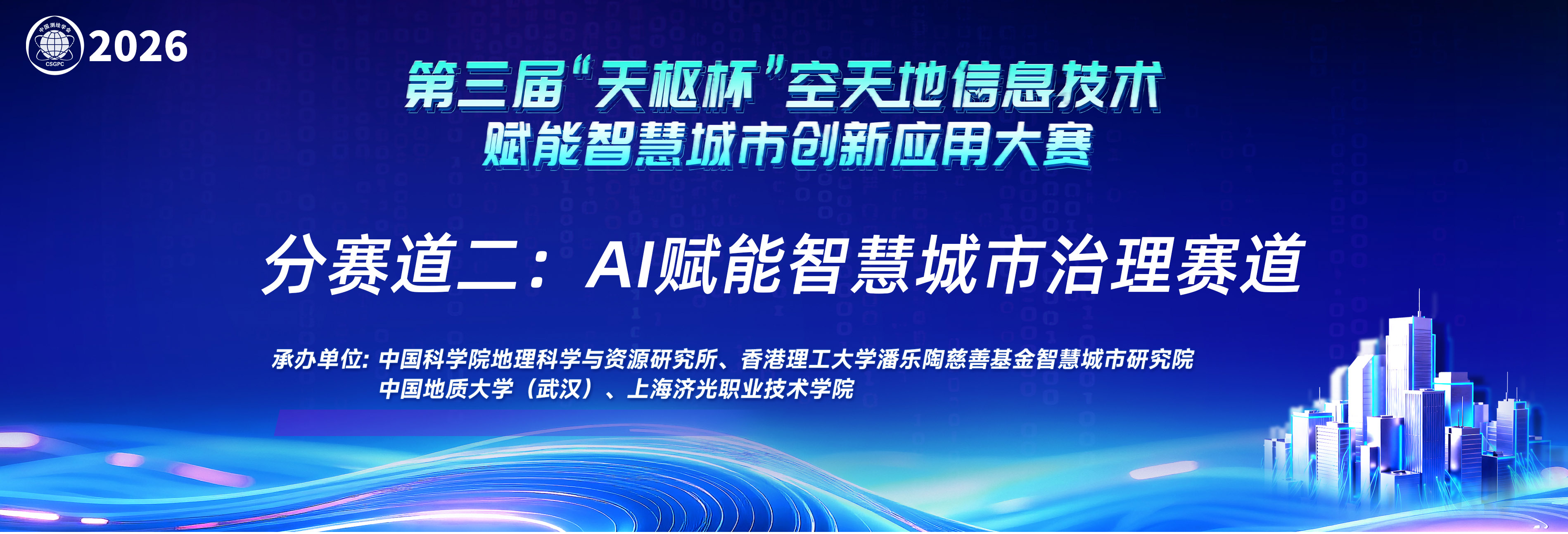
Challenge Title
Large Models for Urban Operational Situation Awareness and Early Warning
Challenge Description:Leveraging the capabilities of large language models and multimodal large models in spatiotemporal data understanding, multi-source information fusion, and logical reasoning, this challenge focuses on potential risks across urban operations. Participants shall carry out situation identification and trend projection, hazard assessment, and risk early warning, thereby promoting a transition in urban governance from “reactive response” to “proactive anticipation and precise prevention and control,” and improving urban risk prevention and control capabilities and emergency-response efficiency.
Core Requirements:
1. Technological Innovation: Deeply integrate frontier technologies such as spatiotemporal big-data mining, collaborative computing for heterogeneous data, intelligent geospatial inference, lightweight fine-tuning of multimodal large models, and instruction optimization, with particular emphasis on the accuracy, efficiency, and reliability of urban operational situation awareness and early warning.
2. Scenario Innovation: Overcome the limitations of conventional situation-awareness and early-warning models. In response to needs in urban transportation operations, the ecological environment, municipal operation and maintenance, disaster emergency response, and public well-being, propose innovative and practical application models based on large-model technologies and methods, highlighting innovation in the application of large models to urban operational situation awareness, early warning, and decision-making.
3. Solution Design: Clearly define the urban application scenario, determine the approach to large-model training and fine-tuning, develop a prototype large model for the selected urban application, and establish a reusable and scalable technical system for situation awareness and early warning. The solution shall demonstrate strong operability.
4. Value Demonstration: Analyze the potential social and economic benefits of implementing the technical solution from such dimensions as emergency-response timeliness, identification and forecasting accuracy, and the benefits of proactive risk anticipation, and demonstrate the solution’s scalability and application prospects.
5. Optional Directions: Specialized designs may focus on urban traffic situation awareness and early warning, prediction and early warning of urban environmental pollution, identification of abnormal crowd gatherings and risk early warning, operating-status identification and fault early warning for municipal facilities, or prediction and early warning of the impacts of extreme weather on cities.
Submission Requirements:
1. Solution Document: Submit a document in PDF format of approximately 5,000 Chinese characters, covering the scenario description and problem analysis, the technical solution, the implementation pathway, and value demonstration.
2. Demonstration Video: Present the application outcomes of the proposed solution in a video of no more than eight minutes.
3. Prototype Demonstration System: Provide an AI-empowered urban operational situation awareness and early-warning platform, together with an access link or a demonstration video.
4. Business Plan (Optional): Applicable to projects with potential for industrialization or commercialization.
Challenge Title
Spatiotemporal Agents for Integrated Urban Governance
Challenge Description:In response to the needs and persistent challenges of refined urban governance, participants shall integrate space-air-ground sensing networks, spatiotemporal big-data mining, digital twins, and artificial intelligence to construct urban spatiotemporal agents capable of autonomous interaction, dynamic decision-making, and coordinated collaboration. The objective is to create a new paradigm for urban governance and raise the level of intelligence, autonomy, and coordination in city management.
Core Requirements:
1. Technological Innovation: Deeply integrate frontier technologies such as space-air-ground integrated sensing, spatiotemporal big-data mining, intelligent UAV inspection, and collaborative multi-agent interaction, highlighting the advantages and innovative value of spatiotemporal-agent technologies in integrated urban governance.
2. Scenario Innovation: Develop application scenarios in response to needs related to transportation and municipal-facility operation and maintenance, ecological and environmental regulation, public-order management, and the coordinated allocation of emergency resources, thereby enabling innovation in urban-governance models.
3. Solution Design: For the selected scenario, design a technical solution with a clear architecture and complete logic, and explicitly define the operating mechanism of the spatiotemporal agents and the division of functional modules.
4. Value Demonstration: Analyze the social and economic benefits of implementing the technical solution from multiple dimensions, including improved governance efficiency, reduced labor costs, and enhanced risk prevention and control capabilities, and demonstrate the solution’s scalability and application prospects.
5. Optional Directions: Specialized designs may focus on urban traffic emergency governance, urban disaster emergency governance, or the inspection and governance of unauthorized urban construction.
Submission Requirements:
1. Solution Document: Submit a document in PDF format of approximately 5,000 Chinese characters, covering the scenario description and problem analysis, the technical solution, the implementation pathway, and value demonstration.
2. Demonstration Video: Present the application outcomes of the proposed solution in a video of no more than eight minutes.
3. Prototype Demonstration System: Provide an integrated urban-governance platform, case studies addressing urban problems, or related demonstration content, together with an access link or a demonstration video.
4. Business Plan (Optional): Applicable to projects with potential for industrialization or commercialization.
Challenge Title
Large-Model-Driven Intelligent Provision and Precise Response for Community Public Services
Challenge Description:This challenge focuses on persistent community-level public-service issues involving elderly care and childcare, healthcare, convenient public services, and residents’ requests and concerns. Participants shall leverage the capabilities of large language models and multimodal large models in community-scene understanding, intent recognition, resource matching, and intelligent interaction, while integrating community spatiotemporal sensing data with government-service data. Solutions shall enable intelligent perception of residents’ needs, precise provision of service resources, and closed-loop handling of public-service requests, thereby promoting a transition in community public services from “reactive response” to “proactive anticipation, precise delivery, and efficient resolution,” and establishing a modern community public-service system that is inclusive and equitable, convenient and efficient, and intelligent and precise.
Core Requirements:
1. Technological Innovation: Deeply integrate frontier technologies such as mining of multi-source community sensing data, large-model intent understanding and sentiment analysis, construction of knowledge graphs for public services, intelligent spatiotemporal resource scheduling, lightweight edge deployment, and instruction optimization, in order to improve recognition accuracy, response efficiency, and the quality of interaction in community public services.
2. Scenario Innovation: Overcome the limitations of conventional community-service models. For high-frequency and essential scenarios such as home-based elderly care, infant and childcare services, community healthcare, convenient daily-life services, public feedback, and assistance for vulnerable groups, propose implementable and reusable service innovation models based on large-model technologies, with emphasis on intelligent, precise, and personalized services.
3. Solution Design: Clearly define the community public-service application scenario, specify the approach to large-model fine-tuning and adaptation, develop a prototype large model for community public services, and establish an end-to-end technical system covering “needs perception - intelligent analysis - resource matching - closed-loop handling - evaluation and feedback.” The solution shall be operable, implementable, and scalable.
4. Value Demonstration: Systematically analyze social and economic benefits from such dimensions as service-response timeliness, the rate of successful resolution of residents’ needs, resident satisfaction, reductions in labor and administrative costs, and improved equity in public-service provision, and demonstrate the solution’s scalability and application prospects.
5. Optional Directions: Specialized designs may focus on intelligent care and emergency assistance for older adults living alone, precise support for vulnerable community groups, intelligent planning of 15-minute convenient living circles, intelligent triage and supervisory follow-up for public-service requests, or intelligent scheduling of meal assistance, medical assistance, and cleaning services for community elderly care.
Submission Requirements:
1. Solution Document: Submit a document in PDF format of approximately 5,000 Chinese characters, covering the scenario description and problem analysis, the technical solution, the implementation pathway, and value demonstration.
2. Demonstration Video: Present the application outcomes of the proposed solution in a video of no more than eight minutes.
3. Prototype Demonstration System: Provide an intelligent community public-service provision and response platform, together with an access link or a demonstration video.
4. Business Plan (Optional): Applicable to projects with potential for industrialization or commercialization.