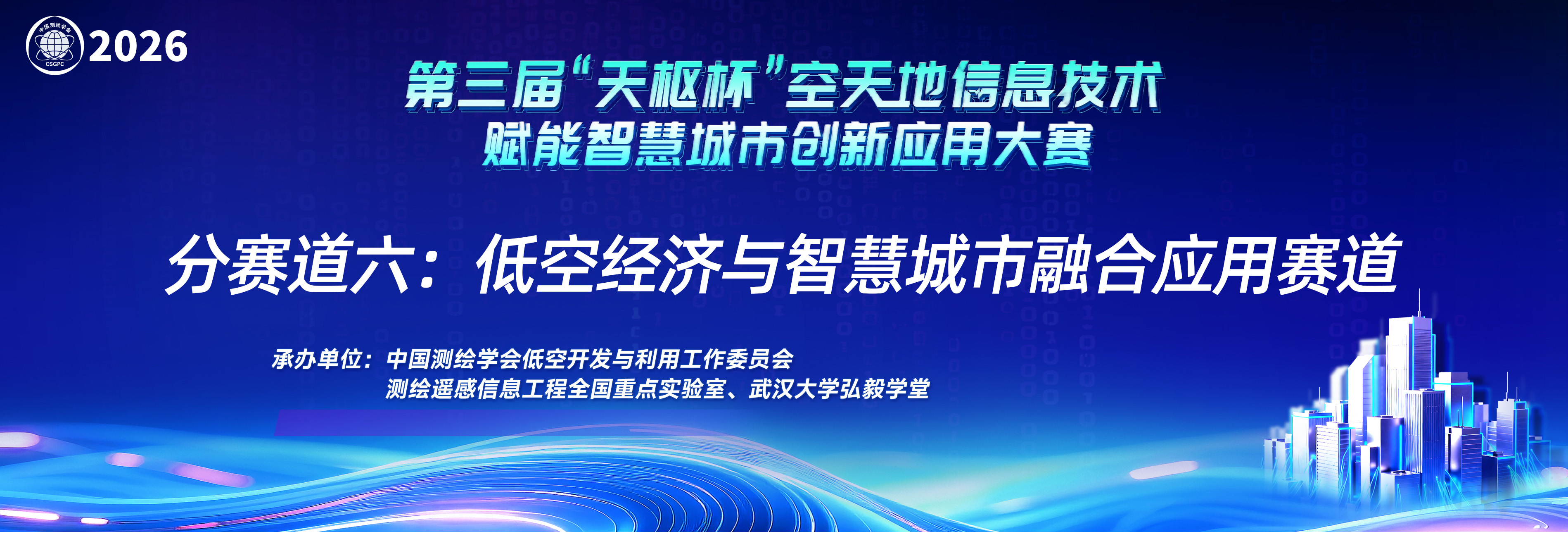
01
Challenge Title
Urban Remote Sensing and Low-Altitude Flight Safety
Challenge Description:This challenge addresses flight-safety risks arising from the large-scale development of the urban low-altitude economy and leverages space-air-ground technologies in surveying and mapping, remote sensing, and geographic information. Participants are encouraged to propose innovative, practical, and implementable technical solutions from perspectives including airspace-environment modeling, dynamic risk perception, intelligent route planning, multi-source data fusion, and coordinated flight control. The objective is to establish a safe, efficient, and intelligent support system for large-scale low-altitude flight operations in cities.
Core Requirements:
1. Scenario Innovation: Propose innovative application scenarios in areas such as smart cities, social governance, public services and people’s livelihoods, and industrial development.
2. Technology Integration: Achieve deep integration between AI technologies and space-air-ground information.
3. Solution: Develop a complete technical solution.
4. Value Demonstration: Analyze the potential benefits of the proposed solution.
Submission Requirements:
1. Solution document: submit a PDF document of approximately 5,000 Chinese characters, including the scenario description and problem analysis, technical solution, implementation pathway, and value demonstration.
2. Demonstration video: demonstrate the application outcomes of the proposed solution. The video shall not exceed eight minutes.
3. Optional prototype demonstration system: provide an accessible URL or a demonstration video.
4. Optional business plan: applicable to projects with potential for industrialization or commercialization.
02
Challenge Title
Typical Smart City Application Scenarios for the Low-Altitude Economy
Challenge Description:This challenge focuses on typical applications of the low-altitude economy in smart cities and explores how low-altitude aircraft, including unmanned aerial vehicles and electric vertical take-off and landing aircraft (eVTOLs), can support urban governance, public services, and industrial upgrading. Participants are encouraged to integrate space-air-ground information technologies with artificial intelligence and develop innovative, implementable, and scalable application solutions in areas such as urban logistics and delivery, infrastructure inspection, emergency rescue, smart culture and tourism, environmental monitoring, and urban air-traffic management. The proposed work should demonstrate the value of deeply integrating the low-altitude economy with smart-city development.
Core Requirements:
1. Scenario Innovation: Propose innovative application scenarios in areas such as smart cities, social governance, public services and people’s livelihoods, and industrial development.
2. Technology Integration: Achieve deep integration between AI technologies and space-air-ground information.
3. Solution: Develop a complete technical solution.
4. Value Demonstration: Analyze the potential benefits of the proposed solution.
Submission Requirements:
1. Solution document: submit a PDF document of approximately 5,000 Chinese characters, including the scenario description and problem analysis, technical solution, implementation pathway, and value demonstration.
2. Demonstration video: demonstrate the application outcomes of the proposed solution. The video shall not exceed eight minutes.
3. Optional prototype demonstration system: provide an accessible URL or a demonstration video.
4. Optional business plan: applicable to projects with potential for industrialization or commercialization.